
The difference between Partizip 1 and Partizip 2 in German
If you want to understand German participles, you need to know the difference between Partizip 1 and Partizip 2 in German. These two forms can look confusing at first, especially because both can be used like adjectives.
But once you understand their meaning, formation, and usage, they become much easier. n this guide, you will learn what Partizip I and Partizip II are, how to form them, when to use them, and how they work with adjective endings in German.
Recommended study materials on the topic:
A-Grammar: Practice German grammar German (incl. answers)
German self-study book for A1-B1 (incl. answers)
German Verb Charts: Learning Regular and Irregular Verbs at a glance
________________________
What are Partizip 1 and Partizip 2 in German?
German has two important participle forms:
Partizip 1, also called Partizip Präsens, usually describes something that is happening now or at the same time as another action. It often has an active meaning.
Partizip 2, also called Partizip Perfekt, is used for the Perfekt, Plusquamperfekt, Passiv, and often also as an adjective.
Examples:
der lachende Mann → the laughing man
der geschriebene Brief → the written letter
die geöffnete Tür → the opened door
The most important difference is this: Partizip 1 describes someone or something that is doing an action. Partizip 2 often describes something that has already happened or is finished
How to Form Partizip 1 in German
The structure of Partizip 1 in German is very simple:
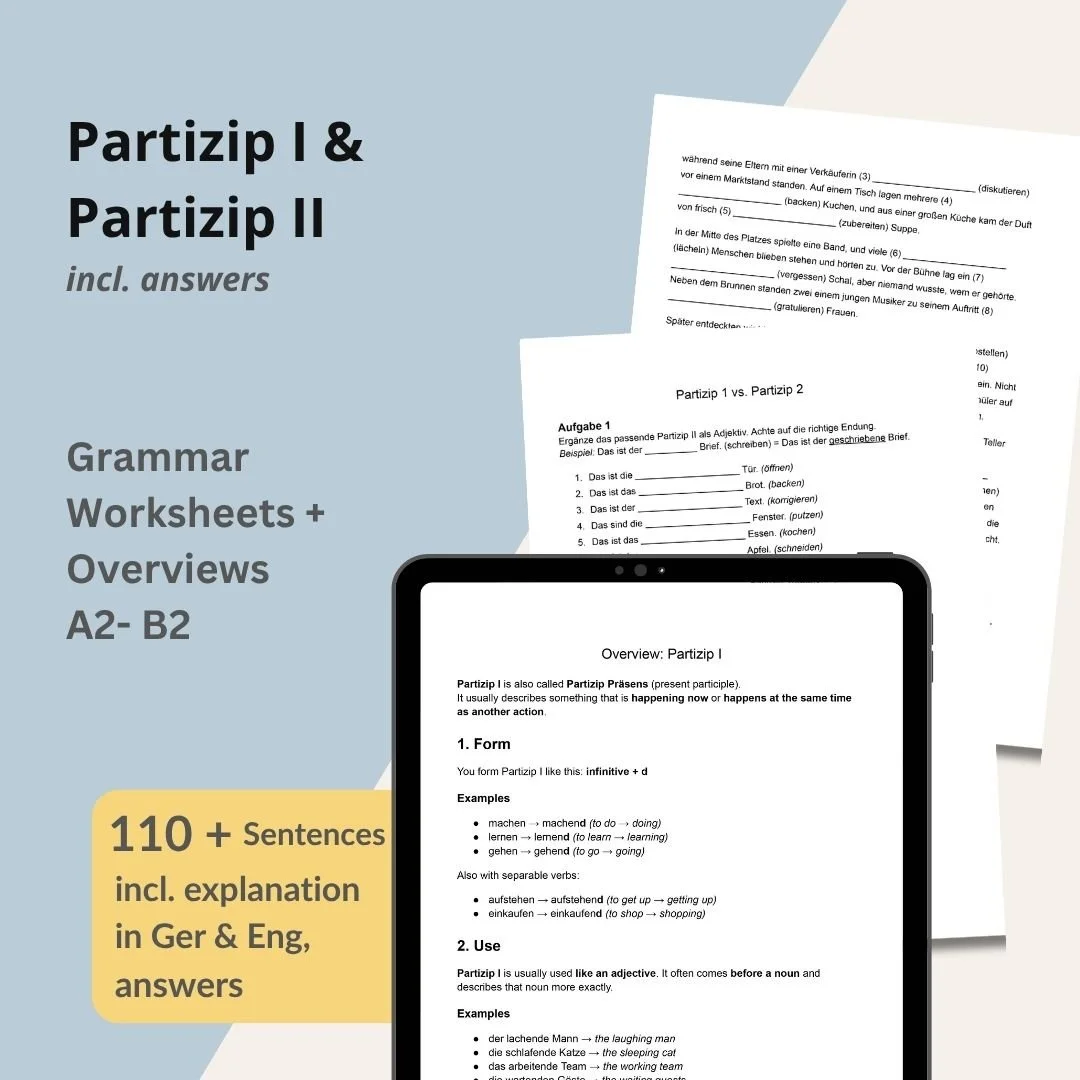
Stop the confusion between verbs in Partizip 1 and Partizip 2 as adjectives! This German Grammar Masterclass is a comprehensive module designed to help A2 to B2 learners finally master the use of Partizip I and Partizip II as descriptive attributes.
Specifically targeting the tricky differences between an ongoing action (der lachende Mann) and a completed state (der geschriebene Brief), this pack bridges the gap between complex participle formation and confident, fluent speech.
Why this Masterclass bundle is a must-have:
Massive Practice Volume: Over 110 active tasks ensure students master the "Active vs. Passive" logic and correct word endings.
Complex Sentence Mastery: Dedicated exercises to help students transform complicated relative clauses into elegant participial attributes—a key skill for B2/C1 exams.
Bilingual Support: Includes clear theory sheets and reference tables in both German and English, making it ideal for self-study or international classrooms.
Full Declension Training: Integrated practice for Adjektivdeklination, ensuring the correct case endings (Nominative, Accusative, Dative, Genitive) are used every time.
What’s Included in this Download:
Bilingual Theory Sheets (DE/EN): Visual tables and logic rules explaining the formation of Partizip I (Infinitive + d) and the various forms of Partizip II (regular, irregular, and separable verbs).
7 Specialized Exercises
Comprehensive Reference Tables: Specialized declension charts for both Partizip I and Partizip II across all genders and cases.
Full Answer Key: A complete Lösungsschlüssel for all 110+ tasks for easy self-correction or fast grading.
All materials are:
Teacher-Created Quality
Flexible Learning Formats
Comprehensive Study Support
infinitive + d
Examples:
lachen → lachend
lernen → lernend
gehen → gehend
arbeiten → arbeitend
warten → wartend
Also with separable verbs:
aufstehen → aufstehend
einkaufen → einkaufend
Partizip 1 is often used before a noun, just like an adjective.
Examples:
der lachende Mann → the laughing man
die schlafende Katze → the sleeping cat
das arbeitende Team → the working team
die wartenden Gäste → the waiting guests
In all these examples, the person or thing is actively doing something.
What Does Partizip 1 Mean?
Partizip 1 usually has an active meaning. That means the noun is doing the action in this moment just like the ending “-ing” in English.
Examples:
der schlafende Hund = der Hund schläft → the sleeping dog = the dog is sleeping now
die singende Frau = die Frau singt → the sining woman = the woman is singing now
die wartenden Leute = die Leute warten → the waiting people = the people are waiting now
Support my free blog content with a kind donation. Thank you!
Important: Partizip 1 Sounds Formal in German
Though Partizip 1 might be grammatically correct to use, it is not always the most natural choice in everyday spoken German.
In many situations, German speakers prefer a relative clause.
Examples:
More natural in everyday German:
die Frau, die am Fenster sitzt
die Leute, die warten
More formal or written German:
die am Fenster sitzende Frau
die wartenden Leute
This is why Partizip 1 is especially useful for written German, formal texts, exams, articles, and advanced grammar practice.
How to Form Partizip 2 in German
Partizip 2 in German is more complex than Partizip 1 because the form depends on the verb type.
You need to know the difference between:
regular verbs
non-separable verbs
Partizip 2 with Regular Verbs
With regular verbs, the verb stem usually stays the same and the Partizip 2 ends in -t.
Basic structure: ge + verb stem + t
Examples:
kaufen → gekauft
machen → gemacht
Partizip 2 with Irregular Verbs
With irregular verbs, the verb stem often changes and the Partizip 2 usually ends in -en.
Basic structure: ge + verb stem + en
Examples:
schreiben → geschrieben
trinken → getrunken
Partizip 2 with Separable Verbs
With separable verbs, ge goes between the prefix and the verb stem.
Basic structure: prefix + ge + verb stem + t / en
Examples:
aufschreiben → aufgeschrieben
einkaufen → eingekauft
Partizip 2 with Non-Separable Verbs
Non-separable verbs do not use ge in the Partizip 2.
Basic structure: __ verb stem + t / en
Examples:
besuchen → besucht
beschreiben → beschrieben
Partizip 2 as an Adjective
Just like Partizip 1, Partizip 2 can also be used like an adjective. In this case, it comes before a noun and describes the noun more exactly.
Examples:
der geschriebene Brief → the written letter
die geöffnete Tür → the opened door
das gekochte Ei → the boiled egg
Partizip 2 often has a passive meaning when it is used as an adjective.
Examples:
der geschriebene Brief = der Brief wurde geschrieben →the letter was written
die geschlossene Tür = die Tür wurde geschlossen → the door was closed
das gekochte Ei = das Ei wurde gekocht → the egg was cooked
This means that something has already happened to the noun.
Partizip 1 vs Partizip 2: What Is the Difference?
Many German learners confuse Partizip 1 and Partizip 2 because both can stand before a noun and work like adjectives. But the meaning is different.
Partizip 1: active meaning
The noun is doing the action in this moment.
Examples:
der schreibende Mann → the writing man
die singende Frau → the singing woman
das spielende Kind → the playing child
Partizip 2: passive or completed meaning
Something has happened to the noun, or the action is finished.
Examples:
der geschriebene Brief → the written letter
die geschlossene Tür → the closed door
das gekochte Essen → the cooked food
Easy rule:
Partizip 1 = doing something like the English “-ing” when translated
Partizip 2 = something has been done or is finished (so you also use this form it in Perfekt)
Adjective Endings with Partizip 1 and Partizip 2
When Partizip 1 or Partizip 2 comes before a noun, it gets the same endings as a normal German adjective (Adjektivdeklination).
Examples with Partizip 1:
der lachende Mann
ein lachender Mann
mit einem lachenden Mann
Examples with Partizip 2:
der geschriebene Brief
ein geschriebener Brief
mit einem geschriebenen Brief
This is why German learners also need to review German adjective declension when learning participles.
The participle form stays the same, but the ending changes depending on gender, case, number, and article.
When to use Partizip 1 and Partizip 2 in German?
You can use German participles in several situations.
1. To describe nouns more precisely
Examples:
der lachende Mann
die geschlossene Tür
das spielende Kind
der geschriebene Text
This is common in written German and formal German.
2. To replace relative clauses
Examples:
die Frau, die lacht → die lachende Frau
der Brief, der geschrieben wurde → der geschriebene Brief
die Kinder, die spielen → die spielenden Kinder
This makes sentences shorter and more compact.
3. To make your German sound more advanced
Partizip constructions are often used in:
written German
formal texts
exams
academic German
newspaper articles
official documents
For everyday conversations, relative clauses often sound more natural.
Practice Partizip 1 and Partizip 2 with a Worksheet Bundle
If you want to understand this topic step by step, I created a German worksheet bundle about Partizip 1 and Partizip 2.
This bundle helps you practise:
the difference between Partizip 1 and Partizip 2
active and passive meaning
Partizip 1 as an adjective
Partizip 2 as an adjective
adjective endings with participles
regular and irregular Partizip 2 forms
sentence transformation with relative clauses
German participle exercises with answers
This worksheet bundle is ideal for German learners from A2 to B2 who want to finally understand how German participles work.
Conclusion
I hoped this article helped you understanding Partizip 1 and Partizip 2 in German. When you know the difference between active meaning and completed or passive meaning, German participles become much easier to use.
If you want to understand German sentence structure even better, read this related article about adjectives with prepositions in German – easy guide & examples.
Bis bald!
Steffie
Related Posts


Hi there, I'm Stefanie, the author of the blog post you're reading.
Please support my work!
Search blog
Learn the clear difference between verschieden and anders in German — with simple rules, examples, and a short memory trick you’ll never forget.