
In German, many adjectives need a fixed preposition. In this easy guide, you will learn the most important adjectives with prepositions in German, how to use them correctly, which case follows, and how word order works. Perfect for A1 to C1 learners.
Recommended study materials on the topic:
A-Grammar: Practice German grammar German (incl. answers)
German self-study book for A1-B1 (incl. answers)
German Verb Charts: Learning Regular and Irregular Verbs at a glance
________________________
What Are Adjectives with Prepositions?
Some German adjectives always need a specific preposition.
You cannot change it.
Examples:
Ich bin interessiert an Deutsch.
Sie ist stolz auf ihren Sohn.
The preposition is fixed.
Important:
After the preposition, you must use the correct case — Akkusativ or Dativ.
Support my free blog content with a kind donation. Thank you!
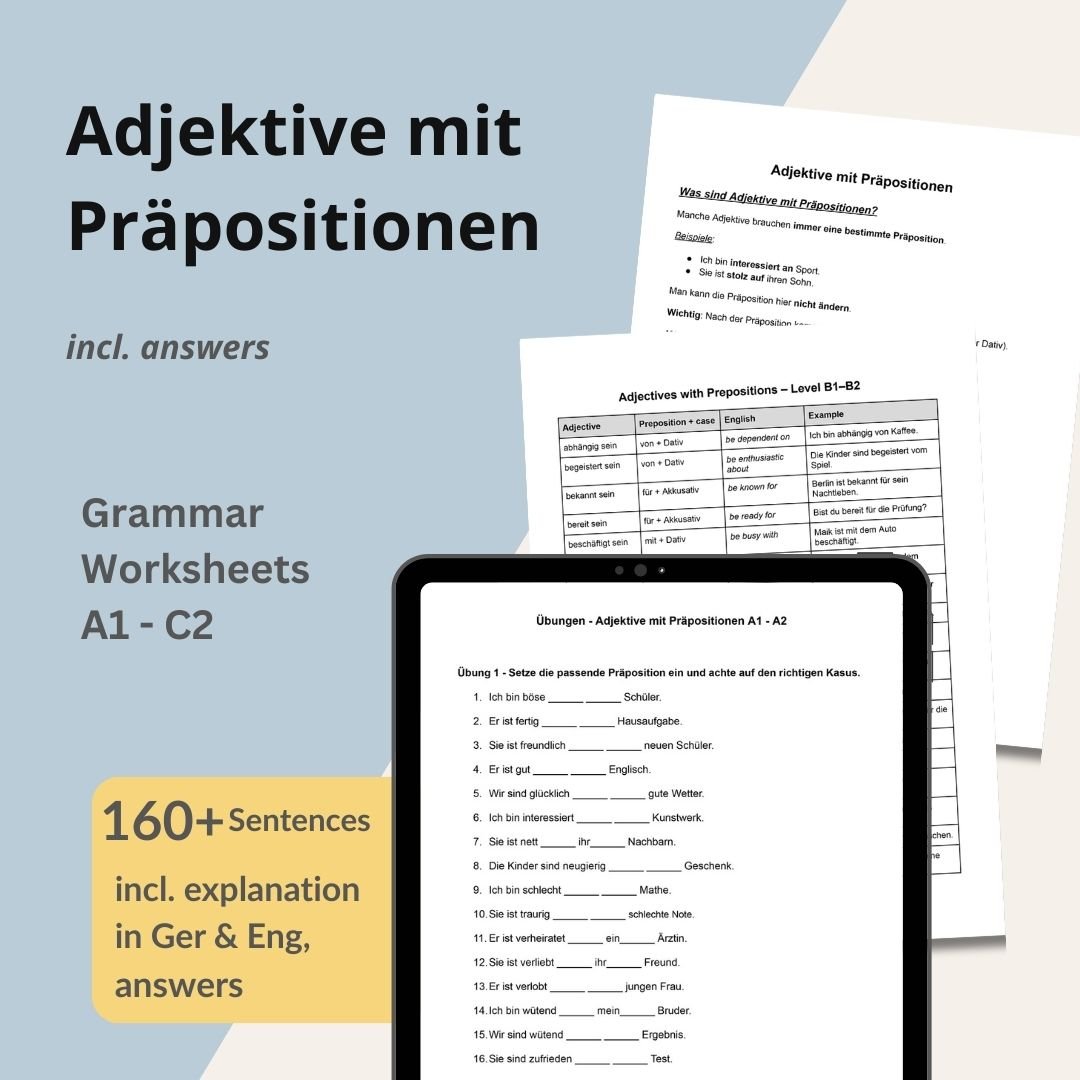
Mastering Adjectives with Prepositions (e.g., interessiert an, stolz auf, abhängig von) is a critical milestone for reaching fluency in German. This comprehensive grammar bundle provides a systematic, level-differentiated approach to learning these essential combinations from A1 all the way to C2.
What’s Included in this 9-Part Bundle:
📘 Beginner Level (A1–A2)
📗 Intermediate Level (B1–B2)
📙 Advanced Level (C1–C2)
each 3 Challenging Exercises with 16 sentences: Focus on academic and professional language.
Task Types: Complex sentence building and contextual training to master stylistic nuances.
Solution Sheet: Dedicated answer key included.
📄 Reference Materials
Comprehensive Overview (German and English)
All materials are:
Teacher-Created Quality
Flexible Learning Formats
Comprehensive Study Support
Word Order: Two Correct Structures
Many learners are confused about word order. The good news: Both forms are correct.
Structure 1 (good for beginners)
Subject + sein + adjective + preposition + object
Example:
Ich bin interessiert an Deutsch.
Sie ist stolz auf ihren Sohn.
This structure is clear and easy.
Structure 2 (more natural in spoken German)
Subject + sein + preposition + object + adjective
Example:
Ich bin an Deutsch interessiert.
Sie ist auf ihren Sohn stolz.
This version sounds more natural in everyday German. Both are correct in exams and in real life.
Adjectives with Prepositions – A1–A2
böse sein auf + Akkusativ
fertig sein mit + Dativ
freundlich sein zu + Dativ
gut sein in + Dativ
glücklich sein über + Akkusativ
interessiert sein an + Dativ
nett sein zu + Dativ
neugierig sein auf + Akkusativ
schlecht sein in + Dativ
traurig sein über + Akkusativ
verheiratet sein mit + Dativ
verliebt sein in + Akkusativ
zufrieden sein mit + Dativ
Adjectives with Prepositions – B1–B2
abhängig sein von + Dativ
begeistert sein von + Dativ
bekannt sein für + Akkusativ
bereit sein für + Akkusativ
enttäuscht sein von + Dativ
geeignet sein für + Akkusativ
neidisch sein auf + Akkusativ
schuldig sein an + Dativ
stolz sein auf + Akkusativ
überzeugt sein von + Dativ
verantwortlich sein für + Akkusativ
wichtig sein für + Akkusativ
Adjectives with Prepositions – C1–C2
angewiesen sein auf + Akkusativ
beteiligt sein an + Dativ
fähig sein zu + Dativ
relevant sein für + Akkusativ
vergleichbar sein mit + Dativ
verrückt sein nach + Dativ
verwandt sein mit + Dativ
How to Learn Adjectives with Prepositions Faster
Here are simple tips:
1. Learn them as a group
Not just “interessiert” — learn:
interessiert sein an + Dativ
2. Always learn with a sentence
Example sentences help your brain remember better.
3. Practice regularly
Use worksheets, short texts, and speaking exercises.
Conclusion
Understanding adjectives with prepositions in German helps you speak more naturally, not just correctly. When you know which preposition belongs to an adjective and which case follows, German sentences become clearer and easier to build.
Instead of guessing, you will feel more confident. You will know why it is interessiert an, stolz auf, or zufrieden mit. That makes a big difference in conversations, exams, and everyday life in Germany.
If you want to understand German sentence structure even better, read this related article about verbs with two objects in German – easy guide & examples.
Bis bald!
Steffie
Related Posts


Hi there, I'm Stefanie, the author of the blog post you're reading.
Please support my work!
Search blog
Learn the clear difference between verschieden and anders in German — with simple rules, examples, and a short memory trick you’ll never forget.