
Verbs With Two Objects in German (Easy Guide + Examples)
Learning German can feel confusing, especially when one verb suddenly needs two objects.
One person. One thing. Different cases. Different word order.
The good news: once you understand the rules, verbs with two objects become very logical.
Recommended study materials on the topic:
A-Grammar: Practice German grammar German (incl. answers)
German self-study book for A1-B1 (incl. answers)
German Verb Charts: Learning Regular and Irregular Verbs at a glance
________________________
What Are Verbs With Two Objects?
Some German verbs connect:
a person
and a thing
The subject does something for someone or to someone.
Example:
Ich schenke meinem Bruder einen Pullover.
I give my brother a sweater.
Here we have:
meinem Bruder (the person)
einen Pullover (the thing)
That means this verb has two objects.
Support my free blog content with a kind donation. Thank you!
The Main Rule: Dative and Accusative
Most German verbs with two objects follow this rule:
Dative = person (who receives something)
Accusative = thing (what is given, sent, shown, etc.)
Common verbs with two objects
geben – to give
schenken – to give as a gift
schicken – to send
zeigen – to show
bringen – to bring
erklären – to explain
Example
Ich gebe meiner Kollegin (Dative) das Dokument (Accusative).
I give my colleague the document.
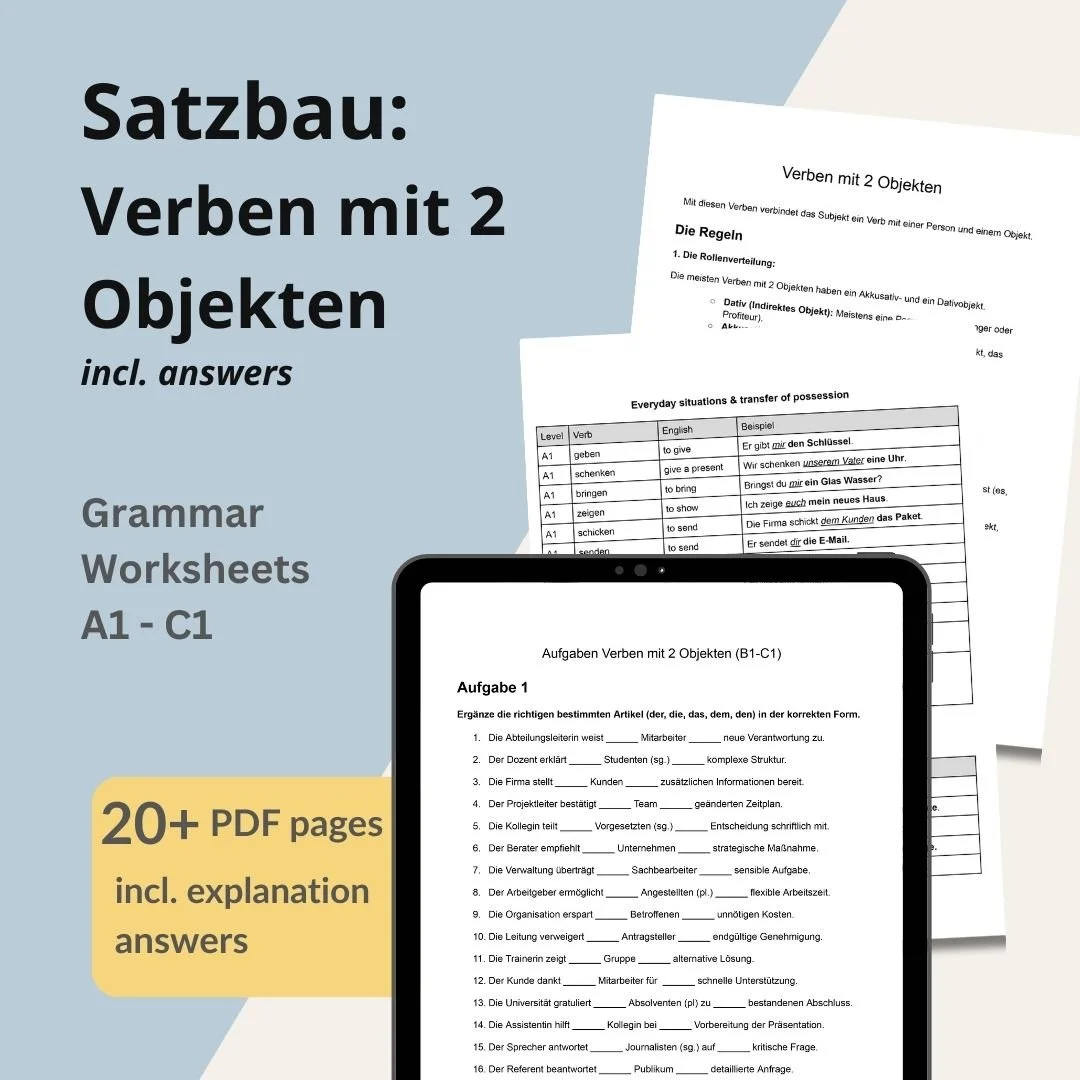
Master one of the most essential yet complex pillars of German sentence structure with this comprehensive printable PDF bundle on Verbs with Two Objects (Akkusativ & Dativ). Designed for learners from A1 to C1, this material provides a systematic, step-by-step approach to using verbs like geben, schenken, schicken, and many more.
Whether you are just starting to place objects in the correct order or you are a professional learner refining your syntax for C1 exams, these German worksheets bridge the gap between simple grammar and fluent, natural communication.
What you will get in this 224-task bundle:
📘 Targeted Exercises (A1–A2):
7 diverse worksheets focusing on foundational structures.
112 practice sentences to build confidence in everyday scenarios.
Full separate answer key for easy self-correction.
📗 Advanced Exercises (B1–C1):
7 high-level worksheets featuring complex sentence building and formal language.
112 advanced practice sentences to master nuance and word order.
Dedicated answer key included.
📂 Comprehensive Reference Material:
2 Bilingual Verb Lists: Essential verbs with two objects, featuring example sentences in both German and English (with translations) for immediate clarity.
2 Grammar Cheat Sheets: Clear, easy-to-follow explanations of the "Who-What-To Whom" logic, provided in both German and English to support all levels.
Important Exceptions You Must Know
Some verbs do not use an accusative object.
helfen
helfen + Dative
often with mit + Dative
Example:
Ich helfe meinem Freund mit den Hausaufgaben.
gratulieren
gratulieren + Dative
often with zu + Dative
Example:
Wir gratulieren ihr zum Geburtstag.
These verbs do not have an accusative object
Word Order Rule 1: Two Nouns
If both objects are nouns, the rule is simple:
Dative comes before accusative
Example:
Ich schenke meinem Bruder (Dat) einen Pullover (Akk).
This is the most common sentence structure in German.
Remember: In German, verbs with two objects usually connect a person (dative) and a thing (accusative).
Word Order Rule 2: Pronouns Change Everything
If one object is a pronoun, word order can change.
Accusative pronoun comes first
Example:
Ich schenke ihn (Akk) ihm (Dat).
This rule is very important and causes many mistakes.
All Variations You Should Recognize
Look at these correct German sentences:
Ich schenke meinem Bruder einen Pullover.
Ich schenke ihm einen Pullover.
Ich schenke ihn meinem Bruder.
Ich schenke ihn ihm.
Practice Makes This Easy
This is exactly why I created my German worksheets on verbs with two objects.
They help you:
understand dative vs accusative
practice word order step by step
learn with clear examples
check your answers easily
Conclusion
Understanding verbs with two objects helps you build clear and natural German sentences, not just grammatically correct ones. When you know who receives something and what is given, German word order becomes much easier and more logical.
If you want to understand the dative even better, read this related article about adding -n in the dative plural in German.
Bis bald!
Steffie
Related Posts


Hi there, I'm Stefanie, the author of the blog post you're reading.
Please support my work!
Search blog
Learn the clear difference between verschieden and anders in German — with simple rules, examples, and a short memory trick you’ll never forget.