
Futur 1 in German: Easy Guide to the German Future Tense
If you want to talk about the future in German, you need to know Futur 1. This tense helps you say what will happen, what you plan to do, and what you think is probably true. If you already know the basics of the German future tense, this deep dive will help you understand Futur 1 in more detail and use it with more confidence.
Recommended study materials on the topic:
A-Grammar: Practice German grammar German (incl. answers)
German self-study book for A1-B1 (incl. answers)
German Verb Charts: Learning Regular and Irregular Verbs at a glance
________________________
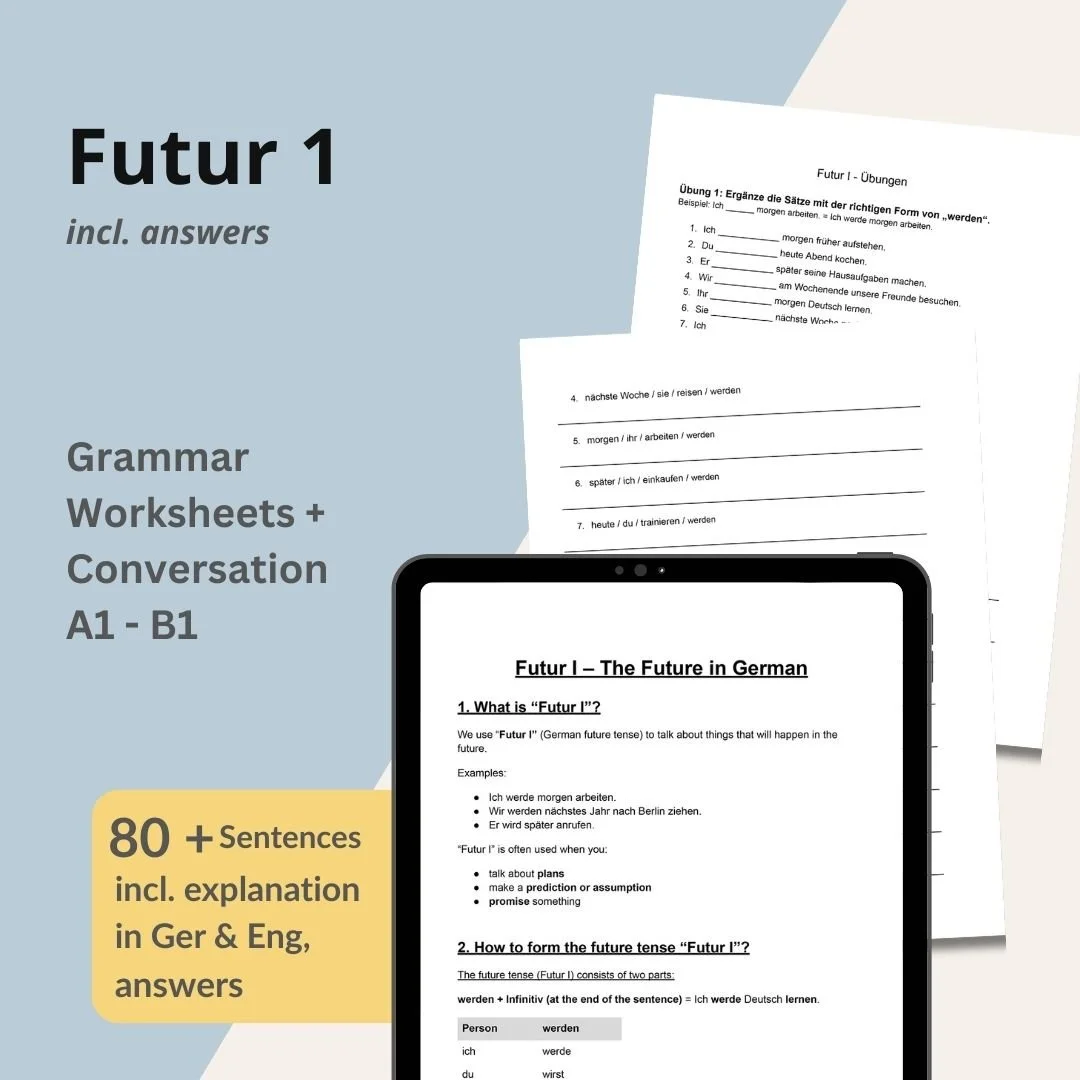
Master the German Future Tense with this all-in-one Futur I Masterclass bundle. Designed for A1–B1 learners, this pack provides a structured path to talking about future plans, making predictions, and expressing assumptions in German.
What you will get in this grammar bundle:
Comprehensive Futur I Mastery: Specialized worksheets covering every aspect of future tense formation, including the correct conjugation of the auxiliary verb "werden" and the essential "infinitive at the end" word order rule.
The "Plan" vs. "Assumption" Distinction: Targeted exercises to help you master the different uses of Futur I, from making firm promises and plans to expressing logical assumptions about the present.
Active Speaking Practice: 16 specialized conversation prompts designed for A2–B2 learners to help you move beyond grammar drills and discuss your future goals, upcoming travel, and global predictions in real-world discussions.
Bilingual Grammar Support: Detailed explanation sheets provided in both German and English to ensure you understand the nuances of when to use Futur I versus the Present tense.
Diverse Sentence Production: Four levels of grammar tasks including conjugation drills, sentence puzzles, and tense transformation exercises to build total confidence in your writing.
All materials are:
Teacher-Created Quality
Flexible Learning Formats
Comprehensive Study Support
What is Futur 1 in German?
Futur 1 is the future tense in German. We use it to talk about things that will happen in the future. It is also used for predictions, promises, and assumptions.
Ich werde morgen arbeiten. → I will work tomorrow.
Wir werden nächstes Jahr nach Berlin ziehen. → We will move to Berlin next year.
Er wird später anrufen. → He will call later.
Futur 1 is an important German grammar topic because it helps you speak about plans and future actions with confidence.
How to form Futur 1 in German
The structure of Futur 1 is very simple:
werden + infinitive
The verb werden is conjugated, and the main verb stays in the infinitive at the end of the sentence. This is the basic rule shown in the worksheet material.
| Person | Werden |
|---|---|
| ich | werde |
| du | wirst |
| er / sie / es | wird |
| wir | werden |
| ihr | werdet |
| sie / Sie | werden |
Support my free blog content with a kind donation. Thank you!
Basic formula
Subject + werden + ... + infinitive
Example:
Ich werde Deutsch lernen. → I will learn German.
Du wirst morgen kommen. → You will come tomorrow.
Wir werden ein neues Auto kaufen. → We will buy a new car.
The most important thing to remember is this: the main verb goes to the end.
When do we use Futur 1?
You can use Futur 1 in German in several ways.
1. To talk about future plans
Use Futur 1 when you want to say what will happen later.
Examples:
Ich werde morgen früh aufstehen. → I will get up early tomorrow.
Wir werden am Wochenende Freunde besuchen. → We will visit friends at the weekend.
Sie wird im Sommer Urlaub machen. → She will go on holiday in the summer.
This is one of the most common uses of the future tense in German.
2. To make a prediction
You can use Futur 1 when you think something will happen.
Examples:
Es wird morgen regnen. → It will rain tomorrow.
Du wirst die Prüfung bestehen. → You will pass the exam.
Das wird schwierig sein. → That will be difficult.
This is helpful when you want to guess or predict the future.
3. To make a promise
Futur 1 can also sound strong and clear when you promise something.
Examples:
Ich werde dir helfen. → I will help you.
Wir werden das Problem lösen. → We will solve the problem.
Ich werde pünktlich sein. → I will be on time.
Futur 1 often sounds more direct and more serious than the present tense.
Futur 1 or present tense in German?
This is a very important point. In German, people often use the present tense to talk about the future, especially when there is a time word like morgen, später, or nächstes Jahr. This is also explained in the source material.
Example with present tense:
Morgen gehe ich zum Arzt.
Example with Futur 1:
Morgen werde ich zum Arzt gehen.
Both are correct. The difference is that Futur 1 often sounds more formal or more strongly emphasized.
So which one should you use?
In everyday German:
Present tense is very common
Futur 1 is used for emphasis, formal speech, or clear predictions
That means you do not need Futur 1 in every future sentence. But you should still learn it well, because it is part of standard German grammar.
Worksheet bundle for Futur 1
If you want more practice, there is also a worksheet bundle for Futur 1. It is a helpful way to review the rules, practice sentence building, and feel more confident with the German future tense.
The worksheet bundle is perfect for self-study, homework, or extra grammar practice. It can help you understand werden + infinitive, use Futur 1 in real sentences, and see when to use Futur 1 or present tense.
Final thoughts on Futur 1 in German
Futur 1 is not difficult once you know the pattern. Start with werden, put the main verb at the end, and practice with short sentences. Then learn the second use too: Futur 1 for assumptions.
If you want to speak and write German more clearly, this tense is worth learning well.
You can also learn how to form the German Partizip 2, because you need it to build the German Perfekt tense.
Bis bald!
Steffie
Conclusion
Related Posts


Hi there, I'm Stefanie, the author of the blog post you're reading.
Please support my work!
Search blog
Learn the clear difference between verschieden and anders in German — with simple rules, examples, and a short memory trick you’ll never forget.